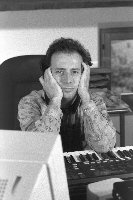
| Enrico Cocco | |
|
|
| spinet pieces | The
Scene of the Crime, World Premier 2004 (dramaturgy of sound for spinet and digital sounds) |
| statement | The crime committed is about the language. Language that changing die, and revive in new forms. The language of a spinet and music today...language of solipsism and of collective artistic work.
The scene is action of four characters there present that exhibit oneself, exorcizing the not linear nature of this music dramaturgy, as a story about the hybridation of the arts. They are Spinet, Audience, Teknè, Beauty. But crime require a victim, a guilty and a feeling of guilt : in this live sound set characters change in turn our role. “...Teknè love Audience, but Spinet, that from distant time fell in love for Beauty, now come under Audience’s spell. |
| link | http://www.cematitalia.it/servizi/profilierepertori/compositori/c/cocco/cocco.htm |
| country | Italy |
| bio | Born in Rome in 1953. He is a composer, sonic researcher, teacher and festival organizer. His multimedia work I Visionari, inspired by a collection of essays by theologian and philosopher Oliviér Clément, was presented at the Cantiere Internazionale d'Arte di Montepulciano (1997). He was invited to present his work Poetico Notturno Silenzio at the Ferienkurse fuer Neue Musik at Darmstadt. His dance work Il Sogno di Chuang-Tzu is based on the short stories of J.L. Borges. He is artistic director of Musica Verticale, a long standing Italian festival on international new music. He is founder of the MusicaExperimento - Musicateatro ensemble, a new group of actors and other performers dedicated to the use of electronic and multimedia techniques in theatre presentations. Cocco has studied with Domenico Guaccero and Mauro Bortolotti and recieved his degree in electronic music from the Conservatorio di S. Cecilia in Rome under the tutalege of Giorgio Nottoli. Since his early experiences with electronic music in the 1970s, he has moved away from pure post-serialist composition and embraced a more personal esthetic of sound dramatics. This has given his works a theatrical quality. His music is influenced by the relationship between sound, theatre and image. Today his interests lie in reseach into how music and drama have shaped the role of the performer. |